Posted on Leave a comment

Following Politicians Is Like Caging Your Future – And Your Children’s Too

Following Politicians Is Like Caging Your Future – And Your Children’s Too

If you’re still queuing behind political parties like APC, PDP, ADC—or any of the elite clubs we call political platforms—pause and ask yourself one simple question:

What have they actually done for you?

Look around.

Nigeria is richly blessed with oil, gas, fertile land, solid minerals, and millions of talented young people. Yet, the average citizen still struggles daily with unreliable electricity, poor roads, unemployment, and a healthcare system where survival often depends on money you don’t have.

So, what went wrong?


1. Laws That Protect Them, Not You

Since 1999, countless laws have been passed—but how many directly made life easier for the average Nigerian?

How many reduced the cost of food, made education truly affordable, or ensured accessible healthcare?

Now compare that to how quickly lawmakers approve:

  • Their salaries and allowances
  • Lifetime pensions after just a few years in office
  • Legal protections and immunity

The system isn’t broken—it’s working exactly as designed. Just not for you.


2. A System Designed to Keep You Out

Nigeria’s political structure isn’t just unfair—it’s intentionally restrictive.

Want to run for office?

Be ready to pay:

  • Millions for nomination forms
  • Hundreds of thousands for “expression of interest”
  • Additional hidden costs along the way

This isn’t democracy—it’s a pay-to-play system.

A teacher, farmer, trader, or fresh graduate doesn’t stand a chance. The high cost acts as a gate, ensuring power remains in the hands of a few wealthy elites who simply rotate positions among themselves.


3. A Nation Rich in Resources, Poor in Priorities

Nigeria has everything it needs to thrive—yet continues to struggle.

  • We produce crude oil but import refined fuel
  • We flare gas but rely on generators
  • We have vast farmland but import food

The issue isn’t lack of resources—it’s misplaced priorities.

Government focus often leans toward:

  • Contracts over community development
  • Convoys over public infrastructure
  • Foreign trips over local investment

Meanwhile, institutions meant to protect citizens remain underfunded or misused.


4. Real Life Reality: Ibrahim’s Story

Consider Ibrahim, a 31-year-old mechanical engineering graduate from Kaduna.

After graduating with a first-class degree in 2017, he spent four years job hunting—without success.

Eventually, he borrowed ₦80,000 to start a small welding business.

Then came the “revenue agents.”

Within one week, they demanded ₦150,000 for various levies. Unable to pay, his shop was locked.

That same week, tragedy struck.

His younger brother was involved in an accident on a poorly maintained road. At the hospital, treatment was delayed due to a ₦210,000 deposit requirement.

He didn’t survive.

Driven by pain and a desire for change, Ibrahim decided to run for councillor.

At the party office, he was told:

  • Nomination form: ₦2.5 million
  • Expression of interest: ₦500,000

He walked away.

Today, Ibrahim is planning to leave the country. His tools sit idle. His dream is fading.

This is the real cost of a broken system.


5. The Cage We’re Building

Every time you:

  • Defend politicians blindly
  • Vote based on tribe or party loyalty
  • Ignore accountability

You help strengthen a system that works against you.

A system where:

  • Your children may still face unemployment decades from now
  • Basic amenities remain luxuries
  • Opportunity depends on connections, not competence

So, What’s the Way Forward?

Supporting any political party without demanding measurable results is like handing over your future without conditions.

Before you support anyone, ask:

Can they show at least five laws or actions that improved the lives of ordinary people in the last four years?

If not, then you’re not supporting democracy—you’re sustaining your own limitations.


Final Thought

Nigeria will not change because we switched party names or logos.

Real change begins when citizens:

  • Demand transparency
  • Reject blind loyalty
  • Support competence over connection

Stop clapping for systems that silence your voice.

Stop financing your own struggle.

Your future—and your children’s future—depends on it.

Posted on Leave a comment

The Commodification of Politics in Nigeria

The Commodification of Politics: How Democracy Suffers

In Nigeria, politics has become a lucrative business, with politicians treating parties as assets to be traded for personal gain.

The ruling party and opposition are increasingly seen as transactional entities, with loyalty sold to the highest bidder.

This trend is eroding democracy, as politicians prioritized power and wealth over public service.

The Opposition’s Dilemma

When opposition parties prioritized personal interests over national welfare, democracy loses. They:

  • Collude with the ruling party to secure perks and influence
  • Sabotage government initiatives to maintaining relevance
  • Trade party interests for personal gain

The People’s Betrayal

Some Nigerians remained loyal to these politicians, despite their self-serving ways. This perpetuates:

  • Corruption and impunity
  • Economic stagnation
  • Poor governance

As one Nigerian activist lamented, “We’re stuck in a cycle of greed and gullibility.”

Breaking the Cycle

Can Nigerians demand accountability and transparency from their leaders? Can politicians prioritized the people over personal gain? The future of Nigerian democracy depends on it.

Do you want to add or change anything?

Posted on Leave a comment

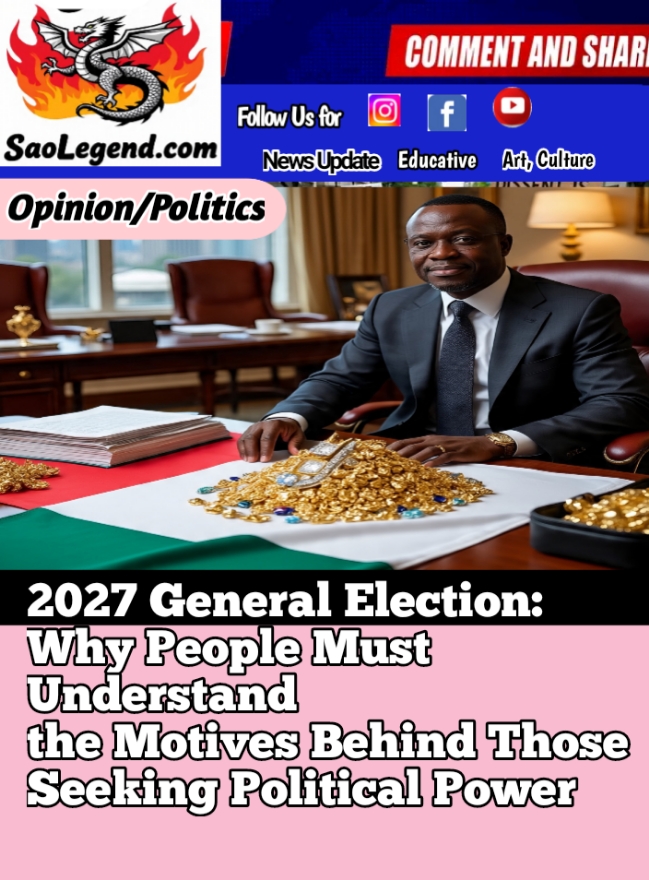
2027 General Election: Why People Must Understand the Motives Behind Those Seeking Political Power

2027 General Election: Why People Must Understand the Motives Behind Those Seeking Political Power

As the 2027 general election approaches, many citizens are asking an important question: What truly drives those seeking political office? While public service should ideally be rooted in a desire to improve lives and strengthen communities, the reality often appears more complex.

The Real Motivation Behind Political Ambition In many cases, political influence is closely tied to wealth, connections, and access to power.

For some candidates, entering politics is less about service and more about maintaining or expanding personal influence.

This helps explain why significant financial resources are often invested in securing positions of authority.

Many individuals have already revealed their intentions—through statements, actions, or past records. In one way or another, it has become clear that the primary motive for some is personal gain rather than a genuine commitment to good governance. In some cases, political ambition is driven by the desire to control financial opportunities and gain access to valuable national resources, rather than to manage them responsibly for the benefit of all.

Why Some Politicians Will Do Anything to Win

Several concerning patterns continue to shape the political landscape: Personal interests over public good: Decisions are sometimes made to benefit individuals rather than the wider population.

Power as protection: Political positions can be used to safeguard personal or business interests.

Neglect of citizens’ needs: Essential issues affecting everyday people may be overlooked or under-prioritized.

The Consequences for SocietyWhen leadership is driven by self-interest, the effects can be far-reaching:Increased hardship: Economic and social challenges persist or worsen for ordinary citizens.

Widening inequality: The gap between the powerful and the vulnerable continues to grow.Slowed national progress: Development stalls when leadership lacks genuine commitment to the people.

Breaking the CycleChange is possible—but it requires active participation from citizens:Demand accountability: Hold leaders responsible for their actions and promises.

Raise expectations: Do not settle for less than transparent and people-focused governance.

Support credible candidates: Choose leaders who demonstrate integrity and a commitment to public service.

Final Thoughts the 2027 general election presents an opportunity to reshape the future. By staying informed, engaged, and intentional about leadership choices, citizens can help build a system that prioritizes people over power.

Posted on Leave a comment

Wealth is a Gift for Everyone

The Power Within: Unlocking Wealth and PurposeWhen we say “Your wealth is in your hands,” it can also be interpreted through a spiritual lens. Many believe that every individual is created with unique gifts, talents, and skills that are divinely ordained. This perspective suggests that our Creator has endowed us with everything we need to succeed and thrive in life.From this viewpoint, the phrase takes on a deeper meaning.

It implies that our wealth—whether material, emotional, or spiritual—is closely tied to how we discover, develop, and utilize the special skills and talents that have been entrusted to us.

It’s about recognizing that we each have a purpose and that fulfilling this purpose is key to unlocking our true potential and achieving prosperity.

This spiritual perspective encourages us to look inward and seek guidance from our faith to understand our strengths and passions. By doing so, we can align our actions and endeavors with our higher purpose, leading to a more fulfilling and successful life. It’s a reminder that our abilities are not just personal assets but also gifts to be used for the greater good, contributing to the well-being of ourselves and those around us.

By Comr sulaiman A. O. Aka Saolegend

Posted on Leave a comment

Your Wealth is in Your Hands: Empowering Yourself through Skills and Entrepreneurship

Your Wealth is in Your Hands: Empowering Yourself through Skills and Entrepreneurship

In a world where economic stability and prosperity are key to a fulfilling life, it’s essential to recognize that the power to achieve these goals lies within us. The phrase “Your wealth is in your hands” is more than just a motivational statement; it’s a call to action. It emphasizes the importance of taking control of our financial futures by investing in ourselves, acquiring new skills, and embracing entrepreneurship.

The Power of Self-Empowerment
Self-empowerment is the foundation upon which wealth creation is built. By believing in our abilities and potential, we open ourselves up to opportunities that might otherwise seem out of reach. This mindset shift from dependency to self-reliance is crucial in today’s fast-paced, ever-changing world. Whether it’s learning a new trade, starting a small business, or innovating solutions to everyday problems, the initiative we take directly impacts our ability to generate wealth.

Skills Development: The Key to Unlocking Potential
One of the most effective ways to ensure financial stability and growth is through continuous skills development. In the digital age, the demand for skilled professionals in various fields such as technology, healthcare, and renewable energy is on the rise. By focusing on acquiring skills that are in high demand, individuals can significantly increase their earning potential and create more opportunities for themselves. Moreover, skills development fosters a culture of lifelong learning, adaptability, and resilience—qualities that are indispensable in navigating the challenges of the modern economy.

Entrepreneurship: Turning Ideas into Wealth
Entrepreneurship is another powerful avenue through which individuals can create wealth. Starting a business, whether small or large, allows individuals to turn their ideas into tangible products or services that meet the needs of their community. It’s a path that requires dedication, hard work, and a willingness to take calculated risks. However, the rewards of entrepreneurship extend beyond financial gains; it also brings a sense of fulfillment and the opportunity to contribute positively to society.

Creating a Prosperous Future
The journey to wealth creation is personal and unique to each individual. It begins with recognizing the potential within oneself and taking deliberate steps towards harnessing that potential. By focusing on skills development and embracing entrepreneurship, individuals can pave their own path to prosperity. It’s about transforming challenges into opportunities and viewing every obstacle as a chance to learn and grow.

In conclusion, the wealth we seek is indeed in our hands. It’s a product of our thoughts, actions, and decisions. By adopting a mindset of self-empowerment, continuously developing our skills, and exploring entrepreneurial ventures, we can unlock our full potential and create a future filled with prosperity and fulfillment. So, let’s take the first step today towards a brighter tomorrow, remembering that our wealth is truly in our hands.

By Comr sulaiman A. O. Aka Saolegend

Posted on Leave a comment

The Power of Self-Discovery: Unlocking Your True Potential

The Power of Self-Discovery: Unlocking Your True Potential

Self-discovery is a fundamental aspect of personal growth and development that every adult should prioritize. It’s the process of understanding your strengths, weaknesses, values, and passions, which ultimately leads to a more fulfilling and purposeful life. By discovering yourself, you unlock the door to your true potential and set yourself up for success in all areas of life.

Why Self-Discovery Matters

Every human being is born with unique skills, talents, and abilities that can be leveraged to achieve greatness. However, without self-discovery, these gifts may remain hidden, and individuals may struggle to find their place in the world. By taking the time to explore your inner self, you’ll gain clarity on your life’s purpose, develop a stronger sense of self-confidence, and make informed decisions that align with your values and goals.

The Benefits of Self-Discovery

  • Increased Self-Awareness: Understanding your thoughts, emotions, and behaviors helps you navigate life’s challenges with more ease and confidence.
  • Improved Relationships: When you know yourself, you’re better equipped to build strong, healthy relationships with others.
  • Career Fulfillment: Discovering your passions and strengths can lead to a more satisfying and successful career.
  • Personal Growth: Self-discovery is a lifelong journey that fosters continuous learning, growth, and self-improvement.

Have You Discovered Yourself?

Now, take a moment to reflect: Have you truly discovered who you are, what drives you, and what you stand for? Are you living a life that aligns with your values and passions? If not, it’s never too late to start your journey of self-discovery. Begin by exploring your interests, values, and strengths. Seek out new experiences, and be open to learning from your mistakes. The path to self-discovery is a rewarding one, filled with growth, transformation, and a deeper understanding of yourself and your place in the world.

If you’re unsure about how to start your self-discovery journey or need guidance on exploring your inner self, don’t hesitate to reach out for support. You can contact +2347054548220 for assistance in discovering yourself through natural and holistic approaches, focusing on personal growth and self-awareness in a way that resonates with your individuality and lifestyle.

Posted on Leave a comment

Exposing Exploitation: How Traditional Leaders in Ilorin Abuse Power Over Land

Exposing Exploitation: How Traditional Leaders in Ilorin Abuse Power Over Land

In Ilorin, the capital city of Kwara State, a disturbing trend has emerged where some traditional leaders are exploiting their power and influence to abuse the rights of ordinary citizens, particularly when it comes to land ownership and distribution. These leaders, who are supposed to be custodians of culture and protectors of their people, are instead using their positions to further their own interests and perpetuate inequality.

The Issue of Land Exploitation

Land, being a vital resource, is frequently at the center of these disputes. Some traditional leaders have been known to allocate land to favored individuals or groups, while denying others their rightful claims. This not only perpetuates inequality but also fuels conflicts and tensions within communities. In some cases, these leaders have been accused of selling community land without the consent or benefit of the people, further exacerbating poverty and displacement.

A Disturbing Trend: Hijacking Land for Royalty

A disturbing trend has also emerged where some traditional leaders, upon assuming office, discover that their own families no longer possess land due to historical circumstances or past mismanagement. In a bid to reclaim wealth and status, these leaders may resort to hijacking land belonging to others, often using their position and influence to exploit vulnerable individuals and communities. This abuse of power for personal gain, under the guise of royalty or traditional authority, further entrenches inequality and injustice.

Abuse of Power and Neglect of Duties

What’s more concerning is that these leaders often neglect their primary roles and responsibilities, which include promoting the welfare and well-being of their subjects, preserving cultural heritage, and maintaining peace and harmony within their communities. Instead, they prioritize personal interests and find ways to exploit their people, whether through land grabs, imposing unfair taxes, or leveraging their authority for financial gain. This dereliction of duty not only erodes trust in traditional institutions but also hampers community development and progress.

Consequences of Exploitation

The consequences of such actions are far-reaching, affecting not only the economic well-being of individuals but also the social fabric of communities. It undermines trust in traditional institutions and can lead to violence and unrest. It’s imperative that measures are taken to ensure accountability and transparency in land dealings, protecting the rights of all citizens, and holding those in positions of power responsible for their actions.

Call to Action

We urge the Emir of Ilorin and other stakeholders to take immediate action to address these allegations and ensure that traditional leaders are held accountable for their actions. It’s time for our leaders to prioritize the welfare and well-being of their people, rather than their own personal interests. By working together, we can create a more just and equitable society where the rights of all are respected and protected.

Posted on 2 Comments

Corruption in the Judiciary: A Threat to Democracy and Economic Growth

Corruption in the judiciary is a big problem for Nigeria’s democracy. When the judiciary is corrupt, it undermines the rule of law and makes people lose trust in institutions. This creates uncertainty for businesses and deters investors from coming to Nigeria.

The Impact on Investment

The Nigerian government has spent a lot of money to attract investors, but it’s not working. Corruption in the judiciary is a major turn-off for investors. They want a stable and predictable business environment, but without a functional and impartial judiciary, they’re hesitant to invest.

The Burden on the Poor

Corruption in the judiciary also hurts the poor and vulnerable. The judicial system is supposed to help people, but it’s become a source of fear and oppression. The rich and powerful exploit this system to cheat and oppress the poor. They cheat the poor and then tell them to go to court, knowing the poor can’t afford justice and the judgment can be bought.

The Need for Reform

To fix this, Nigeria needs to reform its judiciary. This means:

  • Making the judiciary stronger and more independent
  • Improving transparency and accountability
  • Appointing judges based on merit, not connections

Conclusion

Corruption in the judiciary is a serious threat to Nigeria’s democracy and economy. To attract investors and promote growth, Nigeria needs to prioritize judicial reform. Only then can the judiciary serve as a true bastion of hope for the common man.

Posted on 1 Comment

Corruption in the Nigeria Judiciary: A Threat to Democracy and Economic Growth

Corruption in the judiciary is a big problem for Nigeria’s democracy. When the judiciary is corrupt, it undermines the rule of law and makes people lose trust in institutions. This creates uncertainty for businesses and deters investors from coming to Nigeria.

The Impact on Investment

The Nigerian government has spent a lot of money to attract investors, but it’s not working. Corruption in the judiciary is a major turn-off for investors. They want a stable and predictable business environment, but without a functional and impartial judiciary, they’re hesitant to invest.

The Burden on the Poor

Corruption in the judiciary also hurts the poor and vulnerable. The judicial system is supposed to help people, but it’s become a source of fear and oppression. The rich and powerful exploit this system to cheat and oppress the poor. They cheat the poor and then tell them to go to court, knowing the poor can’t afford justice and the judgment can be bought.

The Need for Reform

To fix this, Nigeria needs to reform its judiciary. This means:

– Making the judiciary stronger and more independent
– Improving transparency and accountability
– Appointing judges based on merit, not connections

Conclusion

Corruption in the judiciary is a serious threat to Nigeria’s democracy and economy. To attract investors and promote growth, Nigeria needs to prioritize judicial reform. Only then can the judiciary serve as a true bastion of hope for the common man.

Posted on Leave a comment

Nigerian Judiciary is the Most Corrupt Institution in the World


Nigeria’s judiciary has been embroiled in controversy over corruption allegations, with many questioning its integrity and impartiality. According to a report by the National Bureau of Statistics (NBS) and the United Nations Office on Drugs and Crime (UNODC), judges in Nigeria are among the biggest recipients of bribes, with over N721 billion paid to public officials in 2023.

The State of Corruption in Nigeria

Transparency International’s 2024 Corruption Perceptions Index (CPI) ranked Nigeria 36th among the most corrupt countries globally, tied with Uganda, Mexico, Madagascar, Iraq, and Cameroon, with a score of 26 out of 100. This ranking highlights the need for urgent reform to address the pervasive corruption in the country.

Key Findings on Corruption in Nigeria

– Judicial Corruption: The judiciary is perceived as one of the most corrupt institutions in Nigeria, with judges often awarding favorable rulings to the highest bidder.
– State Capture and Nepotism: Key government appointments are often driven by personal or ethnic affiliations rather than merit, exacerbating inefficiency and corruption.
– Oil Theft and Subsidy Fraud: Nigeria loses billions in revenue to oil theft and subsidy fraud, with little accountability.
– Lack of Political Integrity: The absence of internal democracy and proper campaign finance within political parties breeds corruption and compromises elected officials.

The Impact of Corruption on Nigerian Society

Corruption has eroded trust in Nigeria’s institutions and society, undermining economic growth and development. The crisis of trust in the justice system is a stark indictment of compromised courts, which are widely perceived as politically captured and unable to guarantee impartiality and equitable access to justice.

A Call to Action

To address corruption in Nigeria, there is a need for:
– Judicial Reform: Strengthening the judiciary and ensuring its independence and impartiality.
– Anti-Corruption Efforts: Empowering anti-corruption agencies to investigate and prosecute high-profile cases without political interference.
– Transparency and Accountability: Promoting transparency and accountability in government institutions and public procurement processes.

By working together to address corruption, Nigerians can build a brighter future for themselves and future generations.